Pennsylvania Window Tint Law makes 45% tint a tricky subject because the answer depends on the window, vehicle type, and finished visible light transmission. If you are asking whether 45% total VLT is legal on the front side windows of a car, truck, or SUV in Pennsylvania, the answer is no. PennDOT currently lists a 70% minimum total light transmittance for front side windows and windshields.
The answer changes once you move behind the driver on certain trucks and multipurpose passenger vehicles. PennDOT lists no minimum light-transmittance requirement for rear side windows and the rear window of those vehicle types. That means 45% VLT may be permitted on those rear windows when the vehicle falls into the proper category.
For 1998 and newer passenger cars, the rule is much tighter. PennDOT lists a 70% minimum for the windshield, front side windows, rear side windows, and rear window.
Ceramic Pro Indiana County installs professional window tint at our Ceramic Pro Elite Dealer shop at 7515 US-119 S in Josephine, PA. We serve drivers from Indiana, PA, Kittanning, PA, Blairsville, PA, Punxsutawney, PA, Apollo, PA, and surrounding western Pennsylvania communities.
This guide explains Pennsylvania Window Tint Law, whether 45% tint is legal, what VLT means, why a 45% film may not result in 45% finished VLT, and what drivers should know before choosing a tint shade.
Under Pennsylvania Window Tint Law, 45% total VLT is not legal on every window.
PennDOT’s April 2025 Vehicle Window Tint Fact Sheet lists a minimum of 70% total light transmittance for windshields and front side windows across the vehicle groups shown in its table.
For 1998 and newer passenger cars, PennDOT lists 70% for:
That means a finished 45% VLT reading does not meet PennDOT’s listed 70% minimum on those windows.
Trucks and multipurpose passenger vehicles are treated differently behind the driver.
PennDOT lists:
So, is 45% tint legal in Pennsylvania?
On the front side windows or windshield: no, not as a 45% finished VLT reading under PennDOT’s current table.
On the rear glass of a qualifying truck or multipurpose passenger vehicle: PennDOT lists no minimum light-transmittance requirement.
For a 1998 or newer passenger car, the rear windows still carry the 70% minimum.
A tint percentage usually refers to visible light transmission, or VLT.
A 45% VLT means about 45% of visible light passes through the measured surface.
The lower the VLT number, the darker the window usually appears.
A rough comparison looks like this:
| VLT | General Appearance |
|---|---|
| 70% | Very light |
| 50% | Light |
| 45% | Light to medium |
| 35% | Medium |
| 20% | Dark |
| 5% | Very dark |
These descriptions are only visual references. The actual appearance can change with the vehicle interior, glass color, lighting, film construction, and factory tint.
Pennsylvania Window Tint Law is based on total light transmission through the finished window rather than appearance alone.
That distinction matters.
A window that looks fairly light can still measure below Pennsylvania’s published minimum.
PennDOT separates passenger cars by model year.
For passenger cars from 1998 and newer, its current table lists:
| Window Position | Minimum Total Light Transmittance |
|---|---|
| Windshield | 70% |
| Front side windows | 70% |
| Rear side windows | 70% |
| Rear window | 70% |
For these passenger cars, 45% total VLT falls below the listed minimum on every window in the table.
This applies to many sedans, coupes, and hatchbacks.
A driver cannot assume that rear windows on a sedan can legally be tinted as dark as the rear windows of an SUV.
Pennsylvania Window Tint Law distinguishes between vehicle categories.
PennDOT’s table also treats pre-1998 passenger cars differently at the rear window. The rear window is listed under VESC-20 rather than a simple percentage, while the windshield and side windows remain listed at 70%.
If you own an older vehicle, the rules should be reviewed for that vehicle rather than applying the newer passenger-car table automatically.
The answer to “Is 45% tint legal?” becomes different for trucks and certain SUVs.
PennDOT groups trucks and multipurpose passenger vehicles together in its fact sheet.
For those vehicles, the table lists:
| Window Position | Minimum Total Light Transmittance |
|---|---|
| Windshield | 70% |
| Front side windows | 70% |
| Rear side windows | No requirement listed |
| Rear window | No requirement listed |
PennDOT describes a multipurpose passenger vehicle for purposes of its fact sheet as one built on a truck chassis or designed for occasional off-road use.
This is why a dark rear window on an SUV does not automatically mean the same tint can be used on the front door windows.
The front glass still has the 70% minimum listed by PennDOT.
The rear glass falls into a different category for qualifying vehicles.
If you are unsure how your vehicle is classified, that should be checked before choosing film.
For Pennsylvania Window Tint Law, 45% total VLT does not meet PennDOT’s listed 70% minimum for front side windows.
This applies to the vehicle categories shown in PennDOT’s current fact sheet.
A 45% finished window allows much less light through than a 70% finished window.
There is another issue to watch for.
A film marked “45%” is not necessarily the same thing as a finished window that meters at exactly 45%.
The film goes over factory glass, and that glass already reduces some light.
The final reading will usually be darker than the film’s stated VLT by itself.
That means installing a film simply because the box says a certain percentage is not a good way to predict the finished legal reading.
Sometimes.
This is where Pennsylvania Window Tint Law depends heavily on vehicle type.
PennDOT lists a 70% minimum for rear side windows and the rear window.
A finished 45% VLT reading is below that minimum.
PennDOT lists no minimum light-transmittance requirement for rear side windows and the rear window.
A 45% rear tint can fall within that table because no minimum VLT is listed for those rear positions.
This distinction explains why you may see trucks and SUVs with dark factory privacy glass behind the front doors.
It does not give those vehicles the same allowance on the front windows.
The front side glass still carries the 70% minimum.
A finished 45% VLT windshield does not meet PennDOT’s listed 70% minimum.
Pennsylvania regulations also address material along the top edge of the windshield.
PennDOT Publication 45 states that material along the top edge can be used when it is transparent, does not enter the AS-1 area under federal glazing rules, and does not extend more than three inches down from the top.
That windshield-strip provision should not be confused with permission to tint the entire windshield to 45%.
If windshield heat control is your goal, ask about lighter ceramic film choices rather than assuming a dark film is required.
One of the most misunderstood parts of Pennsylvania Window Tint Law is the difference between film VLT and total VLT.
Suppose a tint film is labeled 70%.
That does not automatically mean the finished window will meter at 70%.
The factory glass already blocks some visible light.
When film is added, light has to pass through both layers.
As a simplified illustration, if factory glass transmitted 80% of visible light and film transmitted 70%, the finished combination would transmit less than either layer on its own.
This is why PennDOT speaks in terms of total minimum light transmittance.
The number that matters is the light passing through the completed window.
For Pennsylvania drivers trying to stay within the published limit, the existing glass needs to be part of the film choice.
Automotive glass is not always 100% clear before tint is installed.
Some glass has a slight color or built-in light reduction from the manufacturer.
Rear privacy glass on trucks and SUVs can be much darker.
Adding aftermarket film over that glass changes the finished reading.
Here is why this matters when researching Pennsylvania Window Tint Law.
Two vehicles can receive the same window film and end up with different total VLT measurements because their factory glass started at different levels.
Even two windows on the same vehicle can have different factory characteristics.
Choosing tint based only on an online photo or another driver’s vehicle can give you a different finished result.
Your vehicle’s glass matters.
Pennsylvania provides a medical exemption process related to vehicle window tint.
PennDOT’s current fact sheet states that medical exemptions are available for colorless window tint products that filter incoming ultraviolet light.
PennDOT directs drivers seeking a medical exemption to its Medical Unit.
The exemption should not be treated as general permission to choose any dark tint percentage.
If you believe you qualify, follow PennDOT’s current process and make sure you understand what the approved exemption allows before film is installed.
PennDOT’s fact sheet currently lists its Medical Unit telephone number as (717) 787-9662.
Questions about window tint materials can also be directed to PennDOT’s Vehicle Inspection Division at (717) 787-2895.
This part of Pennsylvania Window Tint Law creates confusion.
PennDOT’s current Vehicle Window Tint Fact Sheet states that the state eliminated the requirement to check window tint during inspection when it adopted its tint regulations in 1996.
The same fact sheet warns that drivers with tint exceeding the listed light-transmittance requirements can still be stopped and cited while operating the vehicle on a highway.
In plain language, inspection treatment and roadside enforcement are not the same thing.
A driver should not assume tint is lawful merely because the vehicle received an inspection sticker.
PennDOT continues to direct Pennsylvania motorists to its Vehicle Window Tint Fact Sheet for current allowed tint levels.
Ceramic Pro Indiana County offers several window-film choices for drivers who want heat rejection, UV protection, glare control, or a different appearance.
Our window tint service includes Ceramic Pro products designed around different levels of solar control.
Our site includes:
The right film is not always the darkest one.
A vehicle owner who mainly wants less cabin heat can often look toward ceramic films designed for infrared rejection without choosing a very dark VLT.
A common assumption is that darker glass always means better heat rejection.
It does not.
Visible light transmission measures visible light.
Infrared rejection deals with another part of solar energy.
A lighter ceramic film can provide strong infrared rejection while allowing much more visible light through than a dark film.
That can matter a great deal under Pennsylvania Window Tint Law.
If you want to reduce heat but are concerned about the state’s 70% minimum on certain windows, ask about higher-VLT ceramic film rather than automatically looking at 45%, 35%, or 20% tint.
Ceramic Pro’s Ceramic IR and Ultimate IR lines are designed with infrared rejection in mind.
You can review Ceramic Pro Ceramic IR Window Tint and Ceramic Pro Ultimate IR Window Tint before scheduling.
Ceramic Pro Indiana County installs professional window tint at:
7515 US-119 S Josephine, PA 15750
Our hours are:
Monday through Friday 10 AM to 8 PM
We serve vehicle owners from western Pennsylvania communities including:
Ceramic Pro Indiana County is a Ceramic Pro certified installer, vendor, and Ceramic Pro Elite Dealer.
Our business information lists more than 220 reviews with a 5-star rating.
If staying within Pennsylvania Window Tint Law is one of your goals, tell us before choosing the film and shade.
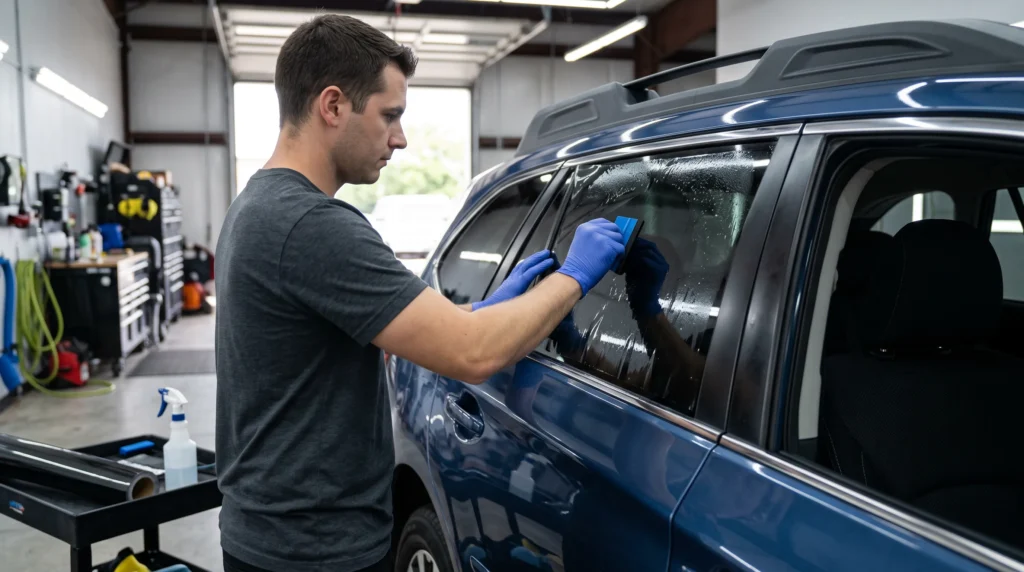
We can discuss your vehicle type, factory glass, desired appearance, and Ceramic Pro film choices.
Pennsylvania Window Tint Law does not make 45% tint legal on every window.
For windshields and front side windows, PennDOT currently lists a 70% minimum total light transmittance.
For 1998 and newer passenger cars, that same 70% minimum extends to the rear side windows and rear window.
For trucks and multipurpose passenger vehicles, PennDOT lists no minimum VLT for rear side windows and the rear window.
Bottom line, the answer depends on where the film is going and what type of vehicle you own.
Do not choose a film solely by the percentage printed on the sample. Factory glass affects the final reading.
Call Ceramic Pro Indiana County at (724) 487-5404 to discuss window tint for your car, truck, SUV, or Tesla.
You can also contact Ceramic Pro Indiana County to request an appointment.
Not on every window. PennDOT lists a 70% minimum total light transmittance for windshields and front side windows. It also lists 70% for rear side windows and the rear window on 1998 and newer passenger cars. Trucks and qualifying multipurpose passenger vehicles have no listed minimum VLT for rear side windows and the rear window.
A finished 45% VLT reading does not meet PennDOT’s current 70% minimum for front side windows. Remember that Pennsylvania looks at total light transmission through the glass and film together.
It depends on the window and how the vehicle is classified. PennDOT lists 70% minimum VLT for the windshield and front side windows of trucks and multipurpose passenger vehicles. It lists no minimum VLT for their rear side windows and rear window.
For a 1998 or newer passenger car, PennDOT lists a 70% minimum total light transmittance for the windshield, front sides, rear sides, and rear window. A finished 45% VLT reading falls below that minimum.
Not necessarily. Factory glass already reduces some visible light. Adding film over it lowers the total amount of light passing through the completed window. The finished VLT can therefore be lower than the film rating by itself.
PennDOT states that medical exemptions are available for colorless tint products that filter incoming ultraviolet light. Drivers should follow PennDOT’s medical exemption process rather than assuming a medical condition permits any tint shade.
Ceramic Pro Indiana County installs Ceramic Pro window film at 7515 US-119 S, Josephine, PA 15750. Call (724) 487-5404 or use our contact page to discuss your vehicle, factory glass, and tint choices.
At Ceramic Pro Indiana County, we offer a full range of auto protection services to keep your car looking its best—and staying protected for the long haul. From scratch-resistant film and gloss-enhancing coatings to UV-blocking window tint, we’re your certified local experts.
Explore the many services we offer by clicking the boxes below