Dealer Window Tint vs Professional Ceramic Tint is worth comparing before you sign off on tint as part of a new-car purchase. A vehicle sitting on the dealer lot may already have dark rear glass, the dealership may offer an aftermarket tint package, or you may be thinking about taking the car to a window tint shop after delivery. Those three situations are not the same.
Factory privacy glass is built into the vehicle’s glass and is mainly intended to reduce visible light and add privacy. Dealer-installed tint is usually an aftermarket film, but the film brand, construction, installer, heat rejection, warranty, and shade can vary from one dealership to another. Professional ceramic tint is an aftermarket window film built with nonmetallic ceramic technology to manage solar heat and UV exposure while maintaining clear electronic signals.
For new-car buyers around Indiana, PA, Josephine, PA, and Homer City, PA, the right choice starts with finding out what is actually on the glass and what the dealer is really offering.
Here is what to check before making your decision.
Dealer Window Tint vs Professional Ceramic Tint is not always a comparison between a bad film and a good film.
Some dealerships use high-grade film and experienced installers. Others sell tint without clearly identifying the manufacturer or product line.
That is why the details matter more than where you buy it.
| Question | Dealer Window Tint | Professional Ceramic Tint |
|---|---|---|
| Film type | Varies by dealer | Known ceramic or carbon product selected before installation |
| Heat rejection | Depends on film | Published by film manufacturer |
| UV rejection | Depends on film | Often 99%+ with quality ceramic films |
| Signal interference | Depends on construction | Ceramic films are nonmetallic |
| VLT choices | Depends on dealer package | Multiple shades usually available |
| Installer | Dealer employee or outside vendor | Window film installer |
| Warranty | Dealer or manufacturer dependent | Manufacturer warranty depends on film |
| Product documentation | May vary | Product line and specifications can be reviewed before installation |
| Factory privacy glass matching | Depends on film | Film can be selected to match OEM rear glass |
| Heat rejection in light shades | Depends on film | High-performing ceramic films can reject IR even at lighter VLTs |
A new-car buyer should ask for the film brand and exact product line before judging dealer tint.
If the dealership can tell you the manufacturer, film series, VLT, heat rejection figures, warranty, and who installs it, you have information you can compare.
If all you are told is “premium tint” or “dealer tint,” there is not enough information to know how the film will perform.
Dealer Window Tint vs Professional Ceramic Tint gets confusing because the term “dealer tint” can describe several different things.
Some new vehicles arrive from the factory with dark rear glass.
This is common on SUVs, crossovers, and trucks.
The darker color is part of the glass rather than an aftermarket film installed at the dealership.
It provides privacy and changes the vehicle’s appearance, but dark factory glass should not automatically be treated as high-heat-rejection ceramic tint.
A dealership may install window film after receiving the vehicle.
Some dealerships have employees who handle accessories in-house. Others send vehicles to an outside tint installer or bring a mobile installer to the dealership.
The quality depends on the film and installation.
A dealer could use dyed film, carbon film, ceramic film, or another type of automotive tint.
This is why Dealer Window Tint vs Professional Ceramic Tint cannot be answered by looking at the sales invoice alone.
You need the name of the film.
Tint may also be sold through the dealership’s accessory department or during the vehicle purchase process.
The fact that it is bundled with the car does not tell you what technology is in the film.
Before accepting the package, ask for written product information.
One of the biggest misunderstandings in Dealer Window Tint vs Professional Ceramic Tint happens when a new SUV or truck already has dark rear windows.
The windows look tinted, so buyers may assume there is nothing left to add.
Factory privacy glass and aftermarket window film have different jobs.
Window film manufacturer LLumar describes factory-installed privacy glass as glass that provides appearance and privacy but lacks strong heat control compared with purpose-built solar-control film.
That means a rear window can look dark without offering the same solar performance as ceramic tint.
Professional ceramic film can be installed on suitable factory privacy glass to add solar-control characteristics while maintaining a similar appearance.
This is especially relevant on SUVs and trucks.
The rear windows may already look dark while the front door glass looks much lighter. A professional installer can select a film intended to match the rear appearance while also considering the heat performance you want.
Ceramic Pro’s Ceramic X Window Tint is designed with an OEM-style black tone that works well when matching factory privacy glass.
Professional ceramic tint is automotive window film that uses microscopic ceramic particles rather than depending mainly on dye or metallic particles.
Ceramic Pro explains that these ceramic particles are nonmetallic and nonconductive.
That construction can help the film manage infrared energy and UV exposure while maintaining clear phone, GPS, radio, Bluetooth, and satellite signals.
Professional ceramic tint can also provide solar protection without requiring extremely dark windows.
That matters for new-car buyers who want a close-to-factory appearance rather than a heavily darkened cabin.
A lighter ceramic film can still have strong infrared performance.
The exact heat rejection depends on the product.
Not every film marketed with the word “ceramic” performs the same way. Look at published specifications for the exact film being offered.
Useful numbers include:
Dealer Window Tint vs Professional Ceramic Tint becomes much easier to compare once those numbers are on the table.
Heat rejection is where many new-car buyers notice the biggest difference between ordinary dark glass and higher-performing window film.
Solar energy entering through automotive glass contributes to cabin heat.
Infrared radiation is one part of that energy.
Professional ceramic tint is designed to reject a portion of that infrared energy before it enters the cabin.
Ceramic Pro currently offers several film levels with different heat performance.
Its national window tint lineup lists:
| Ceramic Pro Film | Construction | Published Maximum Heat Rejection |
|---|---|---|
| Carbon X | Carbon | 95% |
| Ceramic X | Ceramic + Carbon | 96% |
| Ceramic IR | Ceramic | 97% |
| Ultimate IR | Ceramic | 99% |
Different Ceramic Pro pages may also list film-only IR rejection or IR rejection measured across a stated wavelength range. Those measurements should not automatically be treated as interchangeable.
For a new-car buyer, the better approach is to compare the same measurement between two products whenever possible.
The phrase “ceramic tint” by itself does not tell you how much heat a film rejects.
Ask for the specification sheet.
UV protection is another part of Dealer Window Tint vs Professional Ceramic Tint.
Ultraviolet radiation can affect occupants and interior materials.
Over time, sun exposure can contribute to fading and deterioration of seats, dashboards, trim, and other cabin surfaces.
Ceramic Pro’s current window tint lineup lists 99% UV protection across Carbon X, Ceramic X, Ceramic IR, and Ultimate IR.
Ultimate IR is listed at 99%+ UV protection on its dedicated manufacturer page.
That gives buyers a measurable number rather than simply assuming a dark window blocks UV because it looks shaded.
Here is why that matters.
Visible darkness and UV rejection are not the same measurement.
A film can look relatively light while still blocking a very high percentage of UV radiation.
When comparing Dealer Window Tint vs Professional Ceramic Tint, ask what percentage of UV the dealer’s actual film blocks.
If the salesperson does not know, ask for the manufacturer’s data sheet.
No.
Darkness and heat rejection are related to different measurements.
Visible Light Transmission tells you how much visible light passes through the glass and film.
A 5% VLT film is much darker than a 70% or 80% VLT film.
That does not mean the darkest film automatically rejects the most infrared heat.
Professional ceramic tint can reject a large amount of infrared energy while remaining relatively light.
Ceramic Pro Ultimate IR is a good illustration.
Ceramic Pro says its Ultimate IR 80 film can block up to 95% of infrared energy within the manufacturer’s stated test conditions while maintaining a nearly transparent appearance.
This can matter for owners of newer vehicles who want to keep an OEM-style appearance.
It is also useful on larger pieces of automotive glass where making the glass extremely dark may not fit the owner’s goals.
The real question is not, “How dark is it?”
Ask, “What VLT is it, and what heat rejection does that exact film provide?”
Modern vehicles rely heavily on wireless systems.
Drivers use:
Some older metallic window films gained a reputation for affecting certain electronic signals.
Ceramic film avoids that concern by using nonmetallic materials.
Ceramic Pro states that its ceramic films are designed to maintain phone, GPS, and radio signal clarity.
Its Carbon X film is metal-free as well.
Dealer Window Tint vs Professional Ceramic Tint should include this question if the dealer cannot tell you what type of film is being used.
Ask whether the film contains metal.
If the vehicle has many connected systems, a nonmetallic carbon or ceramic film may be the better match.
Many drivers remember older window tint that turned purple, bubbled, peeled, or developed cloudy areas.
Film construction has changed a lot since then.
Quality carbon and ceramic films are designed to resist color changes and adhesive failure when properly installed and cared for.
Ceramic Pro’s window tint lineup is backed by a limited lifetime warranty, with its current manufacturer materials listing coverage against issues such as fading, peeling, cracking, and adhesive failure under the applicable warranty terms.
Dealer-installed tint can have similar warranty protection if the dealership uses a recognized film manufacturer.
Again, the sales channel does not decide film quality by itself.
The product does.
When comparing Dealer Window Tint vs Professional Ceramic Tint, ask:
Those questions tell you more than the words “dealer installed.”
New-car buyers often assume dealership tint is applied by the dealership’s service department.
Sometimes it is.
Sometimes it is not.
A dealership may work with an outside automotive tint shop.
That is not automatically a bad thing. A dealer may have a long-standing relationship with a trained film installer.
The issue is transparency.
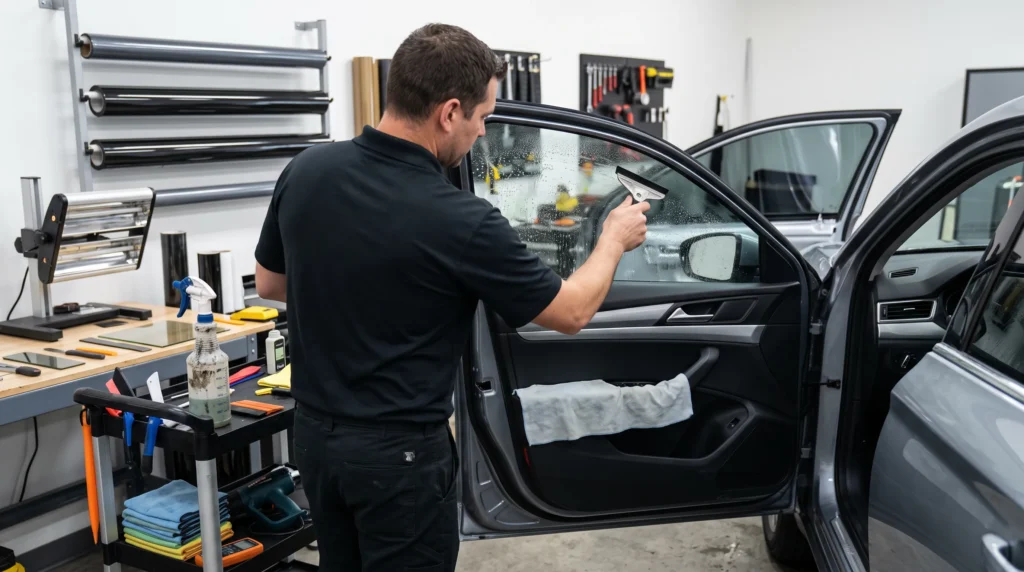
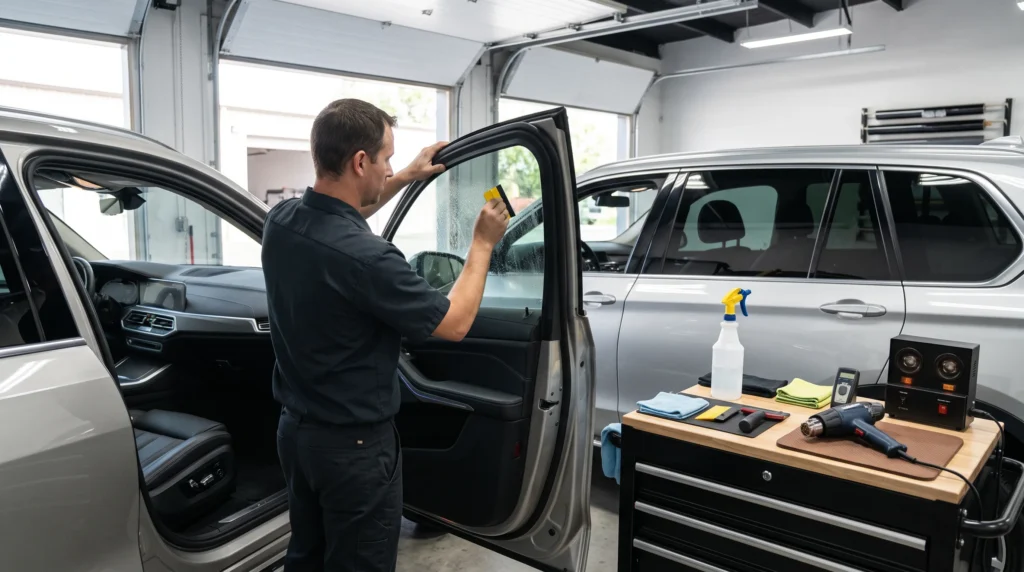
If the tint is part of your new-car purchase, ask who performs the installation.
You can also ask whether the installer works in a controlled indoor environment and what happens if you notice contamination, lifting edges, bubbles, or another installation concern.
Professional tint shops build their workflow around automotive film.
At Ceramic Pro Indiana County, window tint is installed at the Josephine, PA location as part of the shop’s vehicle protection services.
Knowing who installs the tint gives you somewhere to return if you have questions after delivery.
Warranty terms deserve a closer look in Dealer Window Tint vs Professional Ceramic Tint.
A warranty may come from:
Ask for the written warranty before agreeing to the film.
Do not rely only on a statement that the tint is “covered.”
Find out what happens if the film fades, peels, cracks, bubbles, discolors, or experiences adhesive failure.
Ceramic Pro’s current national lineup states that its window films carry a Carfax-documented limited lifetime warranty.
Ceramic Pro’s Ultimate IR page lists lifetime protection against adhesive failure, peeling, delamination, fading, and cracking under its warranty conditions.
Carbon X also has a lifetime manufacturer warranty according to Ceramic Pro.
That gives the vehicle owner a film manufacturer and product line that can be identified later.
If a dealer is offering tint with comparable documentation, that should be part of your comparison.
Dealer Window Tint vs Professional Ceramic Tint can often be decided with a short list of questions.
Before accepting a dealer tint package, ask:
You should be able to identify the manufacturer.
A company may make several tint lines with very different heat rejection and construction.
Knowing the brand without knowing the film series is only part of the answer.
If yes, ask what the manufacturer means by ceramic and review the data sheet.
Do not assume every ceramic product has the same infrared performance.
VLT determines how much visible light passes through the combined glass and film.
The final result matters for appearance and Pennsylvania rules.
This tells you more about heat-focused performance than simply looking at the darkness of the tint.
A quality window film should have published UV data.
Ask whether installation happens in-house or through a vendor.
Get the terms in writing.
Some dealer packages use one standard film and shade. A professional tint shop may give you more ways to match factory privacy glass while working within applicable regulations.
This is worth asking on a new vehicle packed with connected electronics.
Looking through a physical sample can tell you more about color tone and clarity than a brochure image.
These questions turn Dealer Window Tint vs Professional Ceramic Tint into a comparison of actual products rather than sales labels.
Window tint laws should be part of the conversation before any film goes on a new vehicle.
PennDOT’s April 2025 Vehicle Window Tint fact sheet lists minimum total visible light transmission requirements.
For 1998 and newer passenger cars, PennDOT lists 70% minimum light transmission for the windshield, front side windows, rear side windows, and rear window.
For trucks and qualifying multi-purpose passenger vehicles, PennDOT lists 70% for the windshield and front side windows, with no listed minimum for rear side windows or the rear window.
Vehicle classification matters.
So does the total glass-and-film result.
A film labeled 70% VLT does not automatically mean the completed window will measure exactly 70%, because the original automotive glass already has its own light transmission.
PennDOT also states that window tint is no longer checked as part of Pennsylvania’s inspection process, but drivers whose tint exceeds the permitted limits may still be stopped and cited on the highway.
Medical exemptions are available under Pennsylvania rules for qualifying situations.
Because regulations can change, check the current PennDOT Vehicle Window Tint Fact Sheet before choosing a shade.
A professional installer should also discuss the planned VLT before installation.
Ceramic Pro Indiana County offers several film choices for buyers who decide professional tint is the better route.
Carbon X Window Tint uses nano-carbon technology and IR-blocking materials.
Ceramic Pro lists Carbon X at 99% UV protection and places it below its ceramic films in the current product lineup.
Carbon X can make sense for an owner who wants a nonmetallic film and improved heat control without moving to the higher ceramic tiers.
Ceramic X Window Tint uses ceramic and carbon construction.
Ceramic Pro says the film is designed to match the rich black appearance of factory privacy glass.
That makes Ceramic X worth looking at on a new SUV or truck with dark rear privacy glass and lighter front windows.
Ceramic Pro window tint also includes Ceramic IR.
Ceramic Pro’s national lineup places Ceramic IR above Ceramic X for heat rejection, with ceramic construction and multiple VLT choices.
Ultimate IR Window Tint is Ceramic Pro’s highest heat-rejection window film.
Ceramic Pro publishes up to 99% infrared rejection and 99%+ UV protection for Ultimate IR.
The line also includes lighter VLT choices for owners who want solar performance without a heavily darkened appearance.
That can be useful on new vehicles with large windshields, panoramic roofs, or large side glass.
Tesla owners can also review Ceramic Pro Indiana County’s Tesla window tinting options.
Dealer Window Tint vs Professional Ceramic Tint does not have one answer for every new-car buyer.
If your dealership is using a recognized ceramic film, gives you the product specifications, uses an experienced installer, offers the VLT you want, and provides a strong manufacturer warranty, the dealer package may fit your needs.
If the dealership cannot tell you what film is being installed, a professional tint shop gives you a chance to choose the product yourself.
That can matter if heat rejection is one of your main goals.
It also gives you the opportunity to compare different Ceramic Pro window tint lines rather than accepting one dealer package.
Ceramic Pro Indiana County is located at 7515 US-119 S, Josephine, PA 15750, serving vehicle owners from Josephine, PA, Indiana, PA, Homer City, PA, and surrounding communities.
The shop is a Ceramic Pro Elite Dealer and installs Carbon X, Ceramic X, Ceramic IR, Ultimate IR, and other Ceramic Pro automotive protection products.
If your new car already has dark rear privacy glass, bring it in so the existing glass can be compared with your front windows.
The installer can discuss which film tone works with the factory glass and which VLT choices fit your goals and applicable Pennsylvania requirements.
Bottom line, do not judge Dealer Window Tint vs Professional Ceramic Tint by where the tint is sold.
Judge the actual film.
Ask about its construction, IR rejection, UV rejection, VLT, warranty, signal compatibility, installer, and manufacturer.
If those answers are clear, you can make a much better decision before the tint goes on your new vehicle.
To compare Ceramic Pro window tint options, call Ceramic Pro Indiana County at (724) 487-5404 or schedule an appointment through the contact page.
No. Factory privacy glass is manufactured with a darker appearance built into the glass. Dealer window tint usually refers to aftermarket film installed after the vehicle reaches the dealership. A new vehicle can have factory privacy glass on the rear windows and still receive professional film for added heat and UV control.
No. Dealer tint quality depends on the film and installer. Some dealerships use recognized film brands and trained outside installers. Others may offer a film with limited product information. Ask for the film manufacturer, product series, VLT, heat rejection, UV rejection, and written warranty before comparing it with professional ceramic tint.
Not necessarily. Factory privacy glass is mainly designed around appearance and privacy. Window-film manufacturer LLumar states that factory privacy glass can lack strong heat control. Ceramic window film is designed to add solar-control properties, including infrared rejection depending on the product.
No. Ceramic tint can provide infrared and UV protection at lighter VLT levels. Ceramic Pro Ultimate IR is available in lighter shades, including near-clear choices, while still providing high published IR rejection. Darkness and heat rejection are not the same measurement.
Ceramic Pro’s ceramic films are nonmetallic and designed to maintain electronic signal clarity. Carbon X is also metal-free. This makes these films suited to newer vehicles with GPS, Bluetooth, cellular connections, satellite radio, and other wireless systems.
Ask for the manufacturer, film series, film construction, VLT, UV rejection, IR or heat rejection, installer name, and written warranty. You should also confirm whether the dark rear glass is factory privacy glass or aftermarket film. These details make Dealer Window Tint vs Professional Ceramic Tint much easier to compare.
Ceramic Pro Indiana County installs automotive window tint at 7515 US-119 S, Josephine, PA 15750, serving drivers from Indiana, PA, Homer City, PA, and surrounding areas. The shop offers Carbon X, Ceramic X, Ceramic IR, and Ultimate IR window films. Call (724) 487-5404 or contact Ceramic Pro Indiana County to compare films for your new vehicle.
Vehicle Window Tint Fact Sheet
Publisher: Pennsylvania Department of Transportation
Publication Date: April 2025
Used for: Pennsylvania light-transmission requirements, vehicle-class differences, enforcement information, and medical-exemption information.
What Is Ceramic Tint?
Publisher: Ceramic Pro
Updated: September 16, 2026
Used for: Ceramic film construction, infrared rejection, UV protection, nonmetallic construction, signal clarity, VLT, and the difference between darkness and solar performance.
Ceramic Pro Window Tint
Publisher: Ceramic Pro
Publication Date: Not listed
Used for: Current Carbon X, Ceramic X, Ceramic IR, and Ultimate IR lineup, construction, maximum heat-rejection figures, UV protection, VLT choices, and limited lifetime warranty.
Ultimate IR Window Tint
Publisher: Ceramic Pro
Publication Date: Not listed
Used for: Ultimate IR ceramic construction, up to 99% infrared rejection, 99%+ UV protection, light VLT choices, signal compatibility, and lifetime warranty.
Clear Performance Window Film
Publisher: LLumar
Publication Date: Not listed
Used for: Factory privacy glass comparison and the distinction between privacy glass and aftermarket film designed for heat control.
Window Tint in Josephine, PA & Indiana County, PA
Publisher: Ceramic Pro Indiana County
Publication Date: Not listed
Used for: Local Ceramic Pro tint choices, Ceramic Pro Elite Dealer status, shop address, phone number, and service areas.
At Ceramic Pro Indiana County, we offer a full range of auto protection services to keep your car looking its best—and staying protected for the long haul. From scratch-resistant film and gloss-enhancing coatings to UV-blocking window tint, we’re your certified local experts.
Explore the many services we offer by clicking the boxes below