Window Tinting in Kittanning, PA can make your vehicle more comfortable, cut glare, block damaging UV rays, and give the glass a cleaner appearance. The part many vehicle owners struggle with is choosing a film that gives them the look and heat rejection they want while staying within Pennsylvania window tint rules. Pennsylvania regulates how much visible light must pass through certain windows, and the limits depend on the type of vehicle you own.
If you live in Kittanning, PA and are thinking about tinting your car, truck, SUV, or Tesla, learning how visible light transmission works can save you from choosing a film that is darker than Pennsylvania allows. Ceramic Pro Indiana County installs Ceramic Pro window films at our shop at 7515 US-119 S in Josephine, PA. We also serve vehicle owners from Kittanning, Ford City, Apollo, Indiana, Blairsville, and nearby communities.
This guide covers Pennsylvania window tint limits, how VLT is measured, differences between passenger cars and trucks or multipurpose passenger vehicles, and the Ceramic Pro film choices available through our shop.
Window Tinting in Kittanning, PA is governed by Pennsylvania vehicle equipment rules. PennDOT publishes a window tint fact sheet that explains the minimum total light transmittance allowed for common vehicle types.
For a passenger car from model year 1998 or newer, PennDOT lists a minimum of 70% light transmittance for the windshield, front side windows, rear side windows, and rear window. Passenger cars made before 1998 have a different rear-window provision, while the windshield and side windows remain listed at 70%.
That 70% figure refers to the total amount of visible light passing through the finished glass and tint combination. It does not mean that adding film labeled 70% to any factory window will automatically produce a legal 70% reading.
Here is why: automotive glass often has some tint built into it from the factory. When tint film is placed over that glass, the combined VLT can be lower than the film rating by itself. A light film on already tinted factory glass may produce a meter reading below what a vehicle owner expects.
Pennsylvania rules also treat passenger cars differently from trucks and multipurpose passenger vehicles. Before choosing a shade, the vehicle classification and existing glass should be checked.
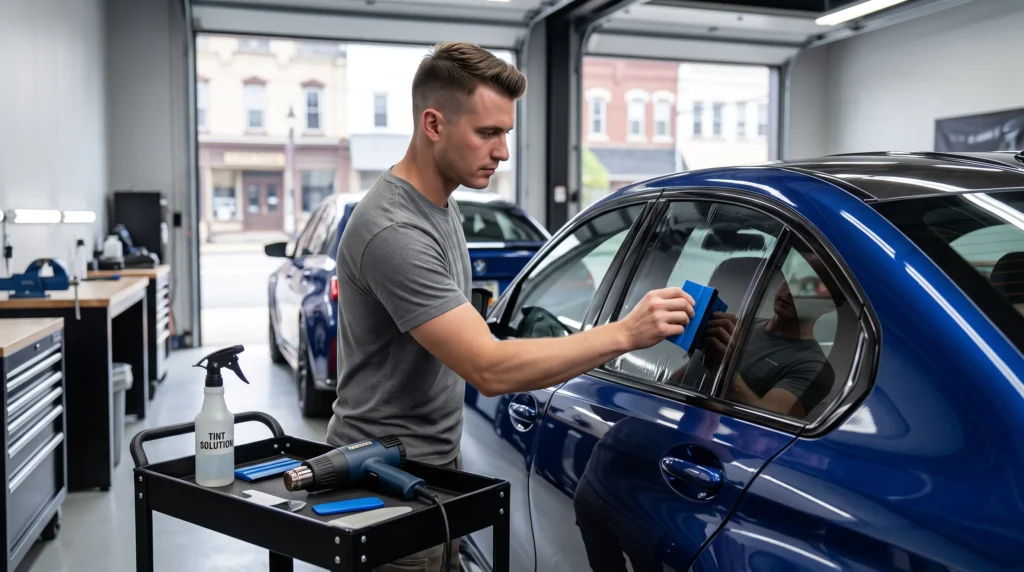
For professional Ceramic Pro window tint, our team can walk you through the film choices available for your vehicle.
VLT stands for visible light transmission. It tells you how much visible light passes through the glass.
A higher VLT number means more visible light passes through the window. A lower number means the glass looks darker.
A 70% VLT reading means roughly 70% of visible light passes through the tested glass. A 20% VLT reading lets much less visible light through and will appear much darker.
What this means for Window Tinting in Kittanning, PA is that the darkness printed on a film sample should not be treated as the final VLT of the window. The glass and film work together.
Suppose factory automotive glass already reduces some visible light. Installing a film rated near 70% over that glass can lower the final reading. This is why choosing tint by appearance alone can create problems.
A professional tint shop can discuss your vehicle type, factory glass, desired appearance, and Pennsylvania rules before film is installed.
For most modern passenger cars, PennDOT’s published table lists the following minimum total light transmittance:
| Window Location | 1998 and Newer Passenger Cars |
|---|---|
| Windshield | 70% |
| Front side windows | 70% |
| Rear side windows | 70% |
| Rear window | 70% |
This distinction matters for owners researching Window Tinting in Kittanning, PA because internet tint charts often group every vehicle together. Pennsylvania does not use one identical rear-glass rule for every vehicle type.
A sedan, coupe, hatchback, pickup, and multipurpose passenger vehicle may not fall under the same rear-window requirements.
If your goal is a darker look, talk with the installer about which windows can legally receive the shade you have in mind. Do not assume that a shade you saw on an SUV can be copied onto a sedan under the same rules.
The real question is not simply, “How dark can I go?” It is, “What finished light-transmission reading applies to my vehicle and each piece of glass?”
That is the safer way to approach Window Tinting in Kittanning, PA.
PennDOT’s table lists a different setup for trucks and multipurpose passenger vehicles.
For these vehicles, the windshield and front side windows are listed at a 70% minimum. PennDOT lists no light-transmittance requirement for the rear side windows and rear window in this vehicle category.
| Window Location | Trucks and Multipurpose Passenger Vehicles |
|---|---|
| Windshield | 70% |
| Front side windows | 70% |
| Rear side windows | No requirement listed |
| Rear window | No requirement listed |
The vehicle classification matters. PennDOT describes a multipurpose passenger vehicle for its tint fact sheet as a vehicle built on a truck chassis or designed for occasional off-road use.
Do not rely only on what the vehicle looks like from the outside. If there is any doubt about classification, confirm it before choosing a rear tint shade.
Vehicle owners looking for Window Tinting in Kittanning, PA can speak with Ceramic Pro Indiana County about Ceramic Pro films for trucks, SUVs, and other vehicles.
The windshield has tighter limits because clear forward visibility matters on public roads.
Pennsylvania’s sun-screening rule permits material along the top edge of the windshield when the material is transparent, does not enter the AS-1 area defined under federal glazing rules, and does not extend more than three inches down from the top of the windshield.
PennDOT lists a 70% light-transmittance minimum for the windshield in the vehicle categories shown in its tint table.
Now here’s the thing: nearly clear window films can still provide strong UV and infrared rejection. A vehicle owner who wants less heat does not always need very dark glass.
This becomes useful when selecting Window Tinting in Kittanning, PA. Film construction and heat rejection can matter just as much as shade.
PennDOT also states that medical exemptions are available for colorless window tint products that filter incoming ultraviolet light. Vehicle owners who believe they qualify should contact PennDOT and follow the state’s exemption process rather than assuming a medical condition automatically permits darker tint.
Ceramic Pro Indiana County carries several Ceramic Pro window film choices. Different film types focus on different levels of heat rejection, UV protection, appearance, and cabin comfort.
Our window tint service includes Ceramic Pro film choices ranging from carbon-based film to ceramic films designed for higher infrared rejection.
The lineup available through our website includes:
The best match depends on what you want from your tint. Some vehicle owners care most about appearance. Others want stronger infrared heat rejection. Some want a lighter shade with high heat control.
Let’s break it down.
Ceramic Pro Carbon CS Window Tint uses nano-carbon film construction rather than traditional metallic film.
Ceramic Pro Indiana County lists Carbon CS as blocking up to 70% of infrared heat and more than 99% of UV rays. The film is metal-free, which helps avoid interference with GPS, mobile phone, Bluetooth, and radio signals.
Carbon CS is available in several VLT choices and comes in black or charcoal tones.
For someone researching Window Tinting in Kittanning, PA, Carbon CS can make sense when you want a clean color-stable appearance, UV protection, glare reduction, and heat control without stepping into the highest ceramic film tier.
The correct shade still depends on the Pennsylvania rules that apply to your vehicle.
Ceramic Pro Ceramic X Window Tint uses ceramic and carbon materials to increase heat rejection while keeping a factory-style dark appearance.
Ceramic Pro describes Ceramic X as a metal-free film, so it is designed to work without disrupting mobile, GPS, Bluetooth, or satellite signals.
Ceramic X can be a good fit for vehicle owners who want to move from carbon film into ceramic construction while keeping a rich black tone that pairs well with factory privacy glass.
For Window Tinting in Kittanning, PA, Ceramic X gives owners another way to balance appearance and heat control while choosing a VLT that fits the vehicle.
Ceramic Pro Ceramic IR Window Tint is aimed at motorists who place more weight on infrared heat rejection.
Ceramic Pro reports that Ceramic IR can block up to 96% of infrared heat. It also blocks more than 99% of UV rays according to Ceramic Pro product information.
Ceramic construction means the film does not depend on metal layers to manage heat. This allows electronic signals to pass without the interference associated with some metallic window films.
Ceramic IR is worth comparing when summer cabin heat, sun exposure, and interior protection matter more than simply making the windows darker.
For many people comparing Window Tinting in Kittanning, PA, this is where the distinction between shade and film performance becomes much easier to see. A lighter ceramic film may control far more heat than a darker low-grade dyed film.
Ceramic Pro Ultimate IR Window Tint sits at the top of Ceramic Pro’s tint lineup.
Ceramic Pro reports infrared rejection of up to 99% for Ultimate IR. The manufacturer also lists more than 99% UV protection and several VLT choices, including lighter films intended to retain a near-factory appearance.
Ceramic Pro’s published film data shows that high-VLT versions can still reject a large share of infrared energy. This makes Ultimate IR appealing to owners who want strong heat control without choosing the darkest possible glass.
Here is why that matters for Window Tinting in Kittanning, PA: Pennsylvania’s 70% rules can make very dark tint unsuitable for many passenger-car windows, but lighter ceramic films can still target heat and UV exposure.
Shade is only one part of the decision.
When comparing Window Tinting in Kittanning, PA, start with four questions:
Once those questions are answered, comparing Carbon CS, Ceramic X, Ceramic IR, and Ultimate IR becomes much easier.
The catch is that choosing tint only from a sample board can overlook the effect of your factory glass. Two vehicles using the same film may not produce the exact same finished meter reading.
This is one reason professional installation matters.
Ceramic Pro Indiana County is a Ceramic Pro Elite Dealer, and our window tint films carry manufacturer warranty coverage. Our shop has 220 reviews with a 5-star rating and serves vehicle owners throughout the region.
Tesla owners have another factor to think about: large glass areas can allow a lot of solar energy into the cabin.
Ceramic films can help control infrared heat while keeping cellular, GPS, Bluetooth, and other electronic signals clear.
Ceramic Pro Indiana County also provides Tesla Window Tinting for Tesla owners from Kittanning, PA and nearby communities.
Cybertruck owners can also read about our Tesla Cybertruck Window Tint service.
Pennsylvania tint limits still apply, so the vehicle and window position should be reviewed before selecting a shade.
Ceramic Pro Indiana County is located at 7515 US-119 S, Josephine, PA 15750.
We work with vehicle owners searching for Window Tinting in Kittanning, PA as well as people coming from nearby service areas listed on our site, including:
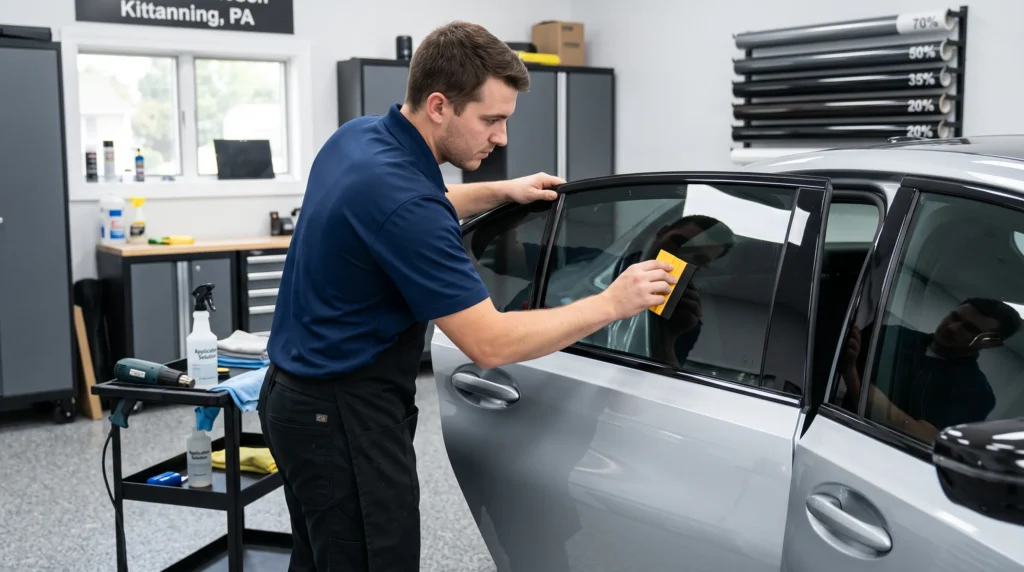
If you are coming from Kittanning, PA, call before your appointment so our team can discuss your vehicle, the windows you want tinted, and the Ceramic Pro film choices that match your goals.
Window Tinting in Kittanning, PA should start with the vehicle, the Pennsylvania VLT rules, and what you want the film to do.
Darkness alone does not tell you how well a tint controls infrared heat or UV exposure. Ceramic Pro’s Carbon CS, Ceramic X, Ceramic IR, and Ultimate IR lines give vehicle owners several ways to choose between appearance, heat rejection, and lighter film choices.
If you want help choosing a Ceramic Pro film for your car, truck, SUV, or Tesla, call Ceramic Pro Indiana County at (724) 487-5404.
You can also contact Ceramic Pro Indiana County to schedule an appointment.
Bottom line: choose the film based on your vehicle classification, finished VLT, heat-control goals, and Pennsylvania rules, not darkness alone.
PennDOT lists a 70% minimum total light transmittance for the windshield, front side windows, rear side windows, and rear window of passenger cars from model year 1998 or newer. Trucks and multipurpose passenger vehicles have a 70% minimum listed for the windshield and front side windows, while PennDOT lists no requirement for their rear side windows and rear window.
Not always. Pennsylvania’s percentage applies to the total light passing through the glass after the film is installed. Factory glass already reduces some light, so adding film labeled 70% can produce a finished reading below 70%. Have the glass and film combination considered before installation.
PennDOT lists no light-transmittance requirement for the rear side windows and rear window of trucks and multipurpose passenger vehicles. The windshield and front side windows are listed at a 70% minimum. Vehicle classification matters, so confirm how your vehicle is treated before selecting film.
No. Ceramic window film can reject infrared heat even in lighter VLT ranges. Ceramic Pro Ultimate IR is sold in lighter shades while retaining high infrared rejection. This can be useful for vehicle owners who want heat control without very dark glass.
Carbon CS works well for owners who want carbon construction, UV protection, and heat control. Ceramic X moves into ceramic and carbon construction. Ceramic IR focuses more heavily on infrared rejection. Ultimate IR is Ceramic Pro’s highest heat-rejection window film line. Your vehicle type, glass, desired shade, and Pennsylvania rules should guide the choice.
Pennsylvania permits certain material along the top edge of the windshield when it is transparent, stays outside the AS-1 area, and does not extend more than three inches from the top. PennDOT lists a 70% minimum light-transmittance level for windshields in its tint table. Ask about your vehicle before adding windshield film.
Call Ceramic Pro Indiana County at (724) 487-5404 or use our contact page to schedule. Our shop is located at 7515 US-119 S, Josephine, PA 15750, and we serve Kittanning, PA along with Ford City, Apollo, Indiana, Blairsville, and other nearby communities.
At Ceramic Pro Indiana County, we offer a full range of auto protection services to keep your car looking its best—and staying protected for the long haul. From scratch-resistant film and gloss-enhancing coatings to UV-blocking window tint, we’re your certified local experts.
Explore the many services we offer by clicking the boxes below