Ceramic IR Window Tint vs Carbon Tint is a common comparison for Pennsylvania drivers who want less heat, reduced glare, UV protection, and a cleaner look without choosing the wrong film for how they use their vehicle. Both film types can improve cabin comfort and appearance, but they are built differently and sit at different levels within the Ceramic Pro window film lineup.
Ceramic Pro Indiana County installs both carbon and ceramic window films at our Ceramic Pro Elite Dealer shop at 7515 US-119 S in Josephine, PA. We serve drivers from Indiana, PA, Kittanning, PA, Blairsville, PA, Punxsutawney, PA, Apollo, PA, Vandergrift, PA, and surrounding western Pennsylvania communities.
For many drivers, the choice comes down to this: Carbon X gives you strong heat rejection, UV protection, a dark color-stable appearance, and metal-free construction at a lower film tier. Ceramic IR moves further toward heat control with a ceramic construction, more VLT choices, and higher published heat rejection.
This guide breaks down Ceramic IR Window Tint vs Carbon Tint for PA drivers, including heat rejection, UV protection, signal clarity, shade choices, appearance, Pennsylvania tint law, and which film may fit different driving habits.
If you are comparing Ceramic IR Window Tint vs Carbon Tint, both can give you UV protection, heat control, glare reduction, and a darker appearance.
The biggest difference is film construction and heat performance.
Ceramic Pro currently lists:
| Feature | Carbon X | Ceramic IR |
|---|---|---|
| Film type | Carbon | Ceramic |
| Maximum heat rejection | Up to 95% | Up to 97% |
| UV protection | 99% | 99% |
| VLT choices | 4 | 7 |
| Warranty | Lifetime | Lifetime |
| Metal-free | Yes | Yes |
Carbon X is aimed at drivers who want strong heat control without moving to a ceramic film.
Ceramic IR is aimed at drivers who want higher heat rejection and more shade choices while using ceramic film construction.
For a Pennsylvania driver, either film may work depending on the window and final total light transmittance.
The film itself is only part of the decision.
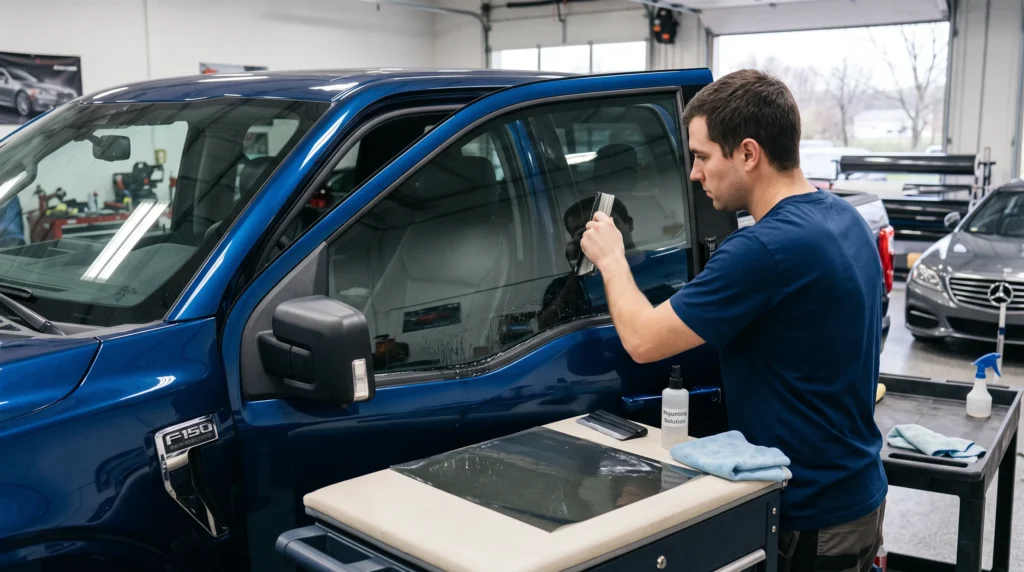
Pennsylvania law, factory glass, vehicle type, and the window being tinted all need to be considered before the final shade is chosen.
Carbon window tint uses carbon-based material within the film rather than relying on metal.
Ceramic Pro Carbon X uses nano-carbon particles along with infrared-blocking materials.
Ceramic Pro states that Carbon X can provide up to 95% infrared heat rejection when installed on automotive glass, depending on the film and test conditions.
It also blocks 99% or more of UV radiation.
Carbon X is metal-free, so it does not create the signal concerns that can come with some metallic films.
That matters for drivers using:
Carbon film also tends to give glass a dark, consistent tone.
For drivers comparing Ceramic IR Window Tint vs Carbon Tint, Carbon X can make sense when you want strong solar control and appearance without moving into the higher ceramic film level.
You can review Ceramic Pro Carbon X Window Tint before scheduling.
Ceramic IR uses ceramic material rather than carbon as its main film construction.
Ceramic Pro Ceramic IR Window Tint uses nano-ceramic technology along with an infrared-focused layer.
Ceramic Pro currently lists Ceramic IR at up to 97% heat rejection in its film comparison.
The manufacturer also lists 99% UV protection.
Ceramic IR is metal-free, so the film is made to let electronic signals pass without the interference associated with metallic tint.
What this means for Ceramic IR Window Tint vs Carbon Tint is that Ceramic IR places more attention on heat rejection.
That can matter for:
Ceramic IR is also offered in more VLT choices than Carbon X according to Ceramic Pro’s current comparison.
That gives drivers more room to choose between lighter and darker film while staying focused on heat control.
Heat rejection is usually the biggest reason a driver starts comparing Ceramic IR Window Tint vs Carbon Tint.
Ceramic Pro currently rates Carbon X at up to 95% heat rejection and Ceramic IR at up to 97%.
That does not mean every shade of each film performs at exactly those numbers.
Film performance changes with VLT and testing method.
Ceramic Pro’s older detailed specification sheet also shows how much readings can change depending on whether the measurement is taken from film alone or film installed over automotive glass.
This is why one percentage should not be viewed without context.
Still, the lineup placement is clear.
Carbon X offers strong heat control.
Ceramic IR sits above it for drivers who want more infrared rejection from a ceramic film.
Here is why that matters in Pennsylvania.
Summer sunlight can heat seats, dashboards, steering wheels, and interior trim while a vehicle sits outside.
A film that reduces more infrared energy entering through the glass can help reduce the heat you feel through the windows.
If cabin heat is the main reason you want tint, Ceramic IR is the stronger choice between these two film types.
Both Carbon X and Ceramic IR provide high UV protection.
Ceramic Pro’s current comparison lists 99% UV protection for both.
That means UV protection by itself may not be the deciding factor in Ceramic IR Window Tint vs Carbon Tint.
Both film types are built to reduce the amount of ultraviolet radiation entering through treated windows.
UV protection can help reduce exposure to:
Window tint does not stop every form of interior aging, but blocking UV exposure can reduce one source of long-term sun exposure.
If UV blocking is your main concern, either film gives you a strong starting point.
The choice may then come down to heat rejection, VLT choices, appearance, and how much time you spend in the vehicle.
Both films can reduce glare.
Glare reduction is closely tied to how much visible light passes through the glass.
A darker VLT will usually cut more visible glare than a lighter VLT within the same film family.
That means glare control is not simply a question of Ceramic IR Window Tint vs Carbon Tint.
Shade matters too.
A darker Carbon X film may cut more visible glare than a much lighter Ceramic IR film because the Carbon X option is allowing less visible light through.
The opposite can be true when comparing similar VLT levels.
Pennsylvania law still needs to guide shade choice on regulated windows.
Do not select a very dark VLT for the front side windows simply because glare is your concern.
A lighter film with strong infrared control may fit the vehicle better while keeping much more visible light coming through.
Both Carbon X and Ceramic IR use metal-free construction.
That gives them an advantage over older metallic tint designs for vehicles filled with wireless electronics.
Ceramic Pro states that Carbon X does not interfere with GPS, cellular, radio, or satellite signals.
Ceramic IR is also built without metal and is designed to retain signal clarity.
That matters more now than it did years ago.
Many modern vehicles rely on wireless systems every time they are driven.
Drivers may use:
For Ceramic IR Window Tint vs Carbon Tint, signal clarity does not need to be the deciding point because both are built for modern vehicle electronics.
VLT stands for visible light transmission.
A higher number allows more visible light through.
A lower number creates a darker appearance.
Ceramic Pro’s current comparison lists Carbon X with four VLT choices and Ceramic IR with seven.
That gives Ceramic IR more choices across the shade range.
This can be useful for Pennsylvania drivers because our state places tighter limits on certain windows.
A driver may want a lighter film on the front side windows and a different shade behind the driver where the vehicle category permits it.
More VLT choices make it easier to build a setup around the vehicle rather than forcing one shade everywhere.
The catch is that film VLT is not the same as finished VLT.
Factory glass already reduces some visible light.
When film is installed over that glass, the final total light transmission drops.
This is why Pennsylvania’s total VLT rules should be considered before film installation.
Appearance comes down to personal taste.
Carbon X has a dark carbon tone and is offered through Ceramic Pro Indiana County in black or charcoal choices.
Ceramic IR is built more around ceramic heat control while still giving the glass a dark automotive appearance.
One driver may prefer the tone of Carbon X.
Another may care more about Ceramic IR’s wider VLT range.
The vehicle itself also changes how tint looks.
Tint can appear different based on:
A light interior can make a tint appear lighter from outside.
A black interior can make the same film look darker.
If appearance carries a lot of weight in your Ceramic IR Window Tint vs Carbon Tint choice, view film samples on automotive glass before deciding.
Pennsylvania drivers need to think about more than film performance.
PennDOT’s April 2025 Vehicle Window Tint Fact Sheet lists the state’s minimum total light-transmittance levels.
For 1998 and newer passenger cars, PennDOT lists:
| Window | Minimum Total Light Transmittance |
|---|---|
| Windshield | 70% |
| Front side windows | 70% |
| Rear side windows | 70% |
| Rear window | 70% |
For trucks and multipurpose passenger vehicles, PennDOT lists:
| Window | Minimum Total Light Transmittance |
|---|---|
| Windshield | 70% |
| Front side windows | 70% |
| Rear side windows | No requirement listed |
| Rear window | No requirement listed |
PennDOT says the listed percentages refer to total minimum light transmittance.
That means the glass and film are considered together.
A film labeled 70% may result in a finished window below 70% because the factory glass already blocks some visible light.
This matters whether you choose Carbon X, Ceramic IR, or another film.
PennDOT also states that tint exceeding its light-transmittance requirements may lead to a traffic stop and citation even though tint is not checked as part of Pennsylvania’s regular vehicle inspection process.
No.
This is one of the strongest reasons PA drivers compare Ceramic IR Window Tint vs Carbon Tint.
Heat rejection and darkness are not the same measurement.
A dark tint blocks more visible light.
A ceramic film can target infrared energy even when the film allows much more visible light through.
That means a driver who wants less heat may not need to chase the darkest tint available.
This is especially useful in Pennsylvania, where front side windows are subject to PennDOT’s 70% minimum total light-transmittance rule.
Drivers who care more about heat than privacy may want to ask about lighter Ceramic IR choices.
A lighter film can preserve a more factory-like look while still putting ceramic film across the glass.
For a daily-use car, both films can work well.
Carbon X may be the better match when you want:
Ceramic IR may fit better when you want:
Think about how the vehicle is used.
A short local commute may make Carbon X more than enough for your needs.
A driver who spends hours on the road, parks outside all day, or strongly dislikes radiant heat through the side glass may prefer Ceramic IR.
Trucks and SUVs often have large windows and factory privacy glass behind the front doors.
That creates a few choices.
Some owners mainly want the front side glass to look closer to the darker factory rear glass.
Others want to add film to rear privacy glass for more solar control.
Factory privacy glass is not the same as ceramic window film.
Glass can look dark without having the same infrared rejection as an aftermarket solar-control film.
For Ceramic IR Window Tint vs Carbon Tint on a truck or SUV, ask whether your goal is:
PennDOT also treats rear windows on trucks and multipurpose passenger vehicles differently from those on modern passenger cars.
That can give some truck and SUV owners more freedom behind the driver while the windshield and front sides remain subject to the 70% minimum.
Tesla vehicles make heat rejection a common concern because many models use large areas of glass.
Ceramic Pro Indiana County provides dedicated Tesla Window Tinting using Ceramic Pro films.
For Tesla owners comparing Ceramic IR Window Tint vs Carbon Tint, both options have metal-free construction.
That makes them suitable for vehicles that rely heavily on wireless communication, GPS, Bluetooth, and connected features.
Carbon X may suit a Tesla owner looking for strong heat control and a dark appearance.
Ceramic IR may suit someone who wants to push further toward infrared rejection.
Cybertruck owners can also review our Tesla Cybertruck Window Tint service.
There is no single winner for every driver.
Choose Carbon X when you want strong heat rejection, carbon construction, UV protection, metal-free film, and a dark appearance.
Choose Ceramic IR when heat rejection carries more weight, you want ceramic construction, or you want more VLT choices.
For PA drivers, legal shade selection needs to come before appearance alone.
A darker film may look better to you but may not meet Pennsylvania’s total light-transmittance rules on the window where you want it installed.
Ceramic Pro Indiana County can discuss your vehicle type, factory glass, desired look, and film choices before installation.
Our shop is located at:
7515 US-119 S Josephine, PA 15750
Our hours are:
Monday through Friday 10 AM to 8 PM
We serve drivers from:
Call (724) 487-5404 to compare Carbon X and Ceramic IR for your car, truck, SUV, or Tesla.
You can also contact Ceramic Pro Indiana County to request an appointment.
Bottom line, Carbon X gives PA drivers strong carbon-film performance, while Ceramic IR moves further toward heat rejection with ceramic construction and more VLT choices. The right film depends on your vehicle, where the film will be installed, and what you want most from the tint.
Ceramic IR has higher published heat rejection and more VLT choices than Carbon X in Ceramic Pro’s current lineup. Carbon X still provides strong heat rejection, UV protection, and metal-free construction. Ceramic IR may fit drivers who place more weight on heat control, while Carbon X may fit owners who want strong performance from a carbon film.
Ceramic Pro’s current window-film comparison lists Ceramic IR at up to 97% heat rejection. Exact performance varies by VLT and test conditions. Ceramic Pro’s dedicated Ceramic IR information also describes the film as using nano-ceramic technology with an infrared-focused layer.
Ceramic Pro currently lists Carbon X at up to 95% heat rejection. Its detailed film information also notes different figures for film-only testing and film installed on automotive glass, so the exact result depends on the film and testing method.
Ceramic Pro currently lists both Carbon X and Ceramic IR at 99% UV protection. UV blocking alone may not be the main reason to choose one over the other. Heat rejection, VLT choices, and film construction create a clearer difference.
Both are metal-free films. Ceramic Pro states that its Carbon X and Ceramic IR products are built to retain signal clarity for GPS, mobile phones, Bluetooth, radio, and other connected systems.
Neither film is automatically legal or illegal. Pennsylvania looks at total light transmittance through the finished glass and film. PennDOT lists a 70% minimum on windshields and front side windows and also on rear glass for 1998 and newer passenger cars. The film VLT and existing factory glass need to be considered together.
Ceramic Pro Indiana County installs both Ceramic IR and Carbon X at 7515 US-119 S, Josephine, PA 15750. Call (724) 487-5404 or use our contact page to discuss your vehicle and film choices.
At Ceramic Pro Indiana County, we offer a full range of auto protection services to keep your car looking its best—and staying protected for the long haul. From scratch-resistant film and gloss-enhancing coatings to UV-blocking window tint, we’re your certified local experts.
Explore the many services we offer by clicking the boxes below